 Bulletin 3/99
back to homepage Bulletin
Last Update: 4-Mar-99
Bulletin 3/99
Square Dance & Round Dance
- Japanese Style Square
Dance und Round Dance auf japanische Art by Martha Ogasawara,
e-mail: martha@blk.mmtr.or.jp
| Did you know that there is
square and round dancing in Japan?? Yes, really!! Can you
imagine everyone dancing in Japanese? Is that beyond the
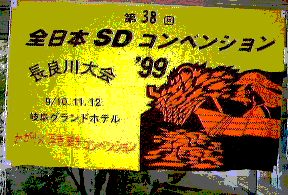
scope of your imagination? Well, I thought I'd take this opportunity to tell you a little more about what the dancing is like here in Japan - both the things that are the same and the things that are different. First of all, let me tell you some of the things that are the same. Remember what I said about everyone dancing in Japanese? Well, I was just kidding. The language of square and round dancing is the same wherever you go. The cuers and callers all cue and call all in English (albeit they may have a Japanese accent). The dancers may not speak English (actually, neither do most of the callers or cuers, except to call and cue), but they can understand all of the necessary square dance terminology. Japanese dancers are known for being very proficient dancers, and this may be due partly to the fact that there was extra effort involved in learning how to dance in another language. Another similarity is that square dancing is based on a system of clubs. There are over 250 square dance clubs in Japan, with about 8,000 members in the Japan Square Dance Association alone. And the number of dancers is steadily growing. The age of the dancers ranges from young children to people in their 70's, with probably the majority being in their 40's and 50's. Some of the older clubs have been around for 50 years, so square and round dancing are not new developments by any means. However, there is a big difference in the structure of the clubs. There are no such things as "couples" and "singles" clubs. In fact, the women outnumber the men by about 4 to 1. Then how does everyone get a chance to dance you may wonder? Simple, a lot of the women do the man's part. Many women can dance both parts, but some women only know the man's part. In any case, it's not considered a problem here. It's usual to change partners for every tip, and even married couples don't usually dance together more than once or twice per dance. Therefore, there's a lot of mixing and anyone can ask anyone else to dance (one of my favorite things about dancing here!). Another difference is the way beginner classes are run. Most clubs hold a beginners class once a year and it is held on the normal club night. The majority of the clubs here dances at the Mainstream level. Everyone in the club helps to angel the new beginners until they graduate; at which point they are naturally absorbed into the club. In general, round dancing is also part of the program for most square dance clubs. Beginners are taught round dancing during beginners class and Phase II-III level dances are included in the program at most dances and festivals. Each club, depending on its size (and they vary from 9 people to 300, with the average at probably about 25), will have several callers and cuers. Most callers and cuers are members of one club and very few of them get paid for their services. Most of the clubs are officer-run, and the callers and cuers will often be officers as well. Clubs meet once a week, and members generally pay monthly dues, instead of paying per dance. Community centers are the most frequent venues for weekly club dances. In addition to the Mainstream clubs, there are quite a number of Advanced and Challenge level clubs as well. While some people dance only at this level, many people continue to belong to a MS club at the same time. The same is true for round dancing. There are many Phase IV-V level round dance clubs. The fact that many of the higher-level dancers continue to support the lower-level clubs is probably another reason why the overall level of dancing is good here. Has this article helped pique your interest in dancing in Japan? Don't you think it would be a wonderful and exotic cultural experience to come and join a room full of Japanese dancers? Even though you might not speak the same language, it wouldn't matter as long as you were dancing together. Well, now we come to my ulterior motive in writing this article! Don't stop reading now!! Every September, the All-Japan Square Dance Convention is held somewhere in Japan. This September 10-12 it will be held in Gifu City, right in the middle of the main island. There are expected to be about 1000 participants and there will be 3 full-time halls going on simultaneously ranging in level from Basic through C2. There will also be a full-time round dance hall. The dancing and accommodations will all be in the same hotel, so everything will be conveniently located under one roof. Doesn't it sound like the chance of a lifetime? If you're interested in finding out more, please write or e-mail the overseas publicity chairman (who just happens to be me - what a coincidence!!). We'd sure love to have you! |
Wußtet Ihr, daß es Square
und Round Dance in Japan gibt?? Ja, wirklich!! Könnt Ihr
Euch vorstellen, wie jemand japanisch tanzt? Oder ist das
jenseits Eures Vorstellungsvermögens? Nun, ich dachte, ich nehme die Gelegenheit wahr, Euch etwas mehr darüber zu erzählen, wie hier in Japan getanzt wird - sowohl über das, was genauso ist, wie das, wo die Dinge anders sind. Zunächst einmal will ich über das reden, was genauso ist. Erinnert Ihr Euch noch, was ich über 'japanisch tanzen' sagte? Nun, das war nur ein Scherz. Die Sprache im Square und Round Dance ist überall dieselbe. Alle Cuer und Caller cuen und callen alles in Englisch (wenn auch vielleicht mit japanischem Akzent). Die Tänzer sprechen meist kein Englisch (tatsächlich auch nicht die meisten Caller und Cuer, außer um zu callen und zu cuen), aber sie verstehen alle notwendigen Square Dance Begriffe. Japaner sind bekannt als sehr tüchtige Tänzer, das kommt vielleicht Teil daher, daß es mit besonderer Mühe verbunden ist, mit einer anderen Sprache tanzen zu lernen. Eine weitere Ähnlichkeit ist, daß der Square Dance auf einem System von Clubs basiert. es gibt über 250 Square Dance Clubs in Japan, mit ungefähr 8.000 Mitgliedern allein in der "Japan Square Dance Association". Und die Zahl der Tänzer wächst ständig. Das Alter der Tänzer reicht von kleinen Kindern bis zu Leuten in den 70ern, wobei die meisten wahrscheinlich zwischen 40 und 50 sind. Einige der älteren Clubs gibt es schon seit ungefähr 50 Jahren, Square und Round Dance sind also auf keinen Fall neue Entwicklungen. Es gibt aber einen großen Unterschied in der Struktur der Clubs (Editor: .. zu den USA). Es gibt keine Dinge wie "Paar-" oder "Single-"Clubs. Tatsächlich übertreffen die Frauen die Männer im Verhältnis 4:1. Wie hat dann jeder eine Gelegenheit zum Tanzen, fragt Ihr Euch? Ganz einfach: eine Menge Frauen tanzen den Männer-Part. Viele Frauen können beide Positionen tanzen, einige aber auch nur die Männerposition. Auf jeden Fall wird das hier nicht als Problem gesehen. Es ist üblich, für jeden Tip den Partner zu wechseln und auch verheiratete Paare tanzen normalerweise nicht mehr als einen oder zwei Tips zusammen. Es wird daher alles gut durchgemischt und jeder kann jeden zum Tanzen bitten (deshalb tanze ich hier besonders gern!). Ein weiterer Unterschied ist die Art, wie Anfänger-Classes laufen. Die meisten Clubs haben einmal im Jahr eine Class und zwar am Clubabend. Die meisten Clubs hier tanzen Mainstream. Jeder im Club hilft den Anfängern als Angel bis sie graduiert werden; zu diesem Zeitpunkt werden sie natürlich in den Club integriert. Im allgemeinen ist Round Dance auch ein Teil des Programms in den meisten Square Dance Clubs. Anfänger werden bereits während der Class in Round Dance unterrichtet und Phase II-III Tänze sind Bestandteil der meisten Tanzabende und Specials. Jeder Club hat abhängig von seiner Größe (die reicht von 9 Tänzern bis 300, durchschnittlich ungefähr 25) mehrere Caller und Cuer. Die meisten Caller und Cuer sind Mitglied eines Clubs und nur sehr wenige werden für ihre Dienste bezahlt. Die meisten Clubs werden von einem Board geführt und die Caller und Cuer sind oft Mitglied des Boards. Die Clubs treffen sich einmal in der Woche und die Mitglieder zahlen meist monatliche Beiträge anstatt je Tanzabend. Gemeindezentren sind der häufigste Treffpunkt für den wöchentlichen Clubabend. Zusätzlich zu den Mainstream-Clubs gibt es auch eine Anzahl Clubs mit Advanced- und Challege-Programm. Während einige Leute nur in diesen Programmen tanzen, bleiben die meisten Tänzer doch gleichzeitig auch Mitglied in einem MS-Club. Dasselbe trifft für Round Dance zu: es gibt viele Phase IV-V RD-Clubs. Die Tatsache, daß viele Tänzer der weiterführenden Programme auch die Mainstream-Clubs unterstützen, ist vielleicht ein weiterer Grund dafür, daß die Tanzfähigkeiten hier im allgemeinen gut sind. Hat dieser Artikel geholfen, Euer Interesse für das Tanzen in Japan zu wecken? Glaubt Ihr nicht, daß es eine wundervolle und exotische Erfahrung wäre, hierherzukommen, mitten in einen Raum voller japanischer Tänzer? Obwohl Ihr vielleicht nicht dieselbe Sprache sprecht, stört das nicht weiter, solange Ihr zusammen tanzt. Nun, damit kommen wir zum letzten Grund, weshalb ich diesen Artikel geschrieben habe! Hört jetzt nicht auf zu lesen! Jeden September findet die "All-Japan Square Dance Convention" irgendwo in Japan statt. Diesmal vom 10.-12. September in Gifu, genau in der Mitte der Hauptinsel. Es werden ungefähr 1000 Teilnehmer erwartet und es gibt parallel drei Hallen mit den Programmen von Basic bis C2. Außerdem gibt es durchgängig eine Halle für Round Dance. Tanz und Unterkunft sind im selben Hotel, es liegt daher alles bequem unter einem Dach beieinander. Klingt das nicht nach einer einmaligen Gelegenheit? Wenn Ihr interessiert seid, mehr zu erfahren, schreibt bitte oder schickt ein e-mail an die Verantwortliche für die Werbung in Übersee (was ich grade bin - welch Zufall!!). Wir würden Euch gern bei uns sehen! Übers.: Editor |
For more information, write / Für weitere Information schreibt bitte an
| Location | # of clubs | # of members | # of couples | # of "solo" men | # of "solo" women |
| Hokkaido | 28 | 607 | 51 | 89 | 518 |
| North East | 20 | 590 | 69 | 102 | 488 |
| Kanto (Tokyo) | 98 | 3358 | 435 | 838 | 2520 |
| Nagoya | 52 | 1420 | 177 | 355 | 1065 |
| Osaka | 23 | 1155 | 68 | 125 | 1030 |
| West | 32 | 700 | 74 | 129 | 571 |
| Total | 253 | 7830 | 874 | 1638 | 6192 |

Travelogue / Reisebericht Japan
by Walter, Gateway Twirlers & Colors of the Wind
| It's a small world …
at least the Square Dance World is. We had just finished
the article concerning Square Dancing in Japan when the
following article popped in in which the subject was the
same person with whom we had corresponded on the article
and flyer concerning "All-Japan Square Dance
Convention". In 1994, the theme of our Special Dance was "Gateway Twirlers travel to Japan". The previous year's success of our decoration spurred my ambition to build something again for this year. Asking for ideas, I wrote to a few addresses in the International Directory. Though I received many good wishes, copies, coloured copies, reports and even books about the construction of tea houses, there was nothing of which I could make use. Thus, I made a quick decision and flew to Japan for the first time in September 1994. Unfortunately, a carpenter in general - and myself in particular - is lazy about writing. I can lift lumber all day, saw and nail but to pick up a pen is too heavy. Additionally, where should I begin and where should I stop in describing these three weeks. Here in brief are my experiences reminding me of the advice: "Please call before visiting". Well equipped with a Youth Hostel pass, the International Directory and some letters I had received from Japan, I did not see any problems for my three weeks' stay. I bought a Junior ticket enabling me to use all the trains of the Japanese Railways without standing in line for a ticket. Two addresses had caught my attention; the office of the "Japanese Square Dance Association" was located in the same street as the Youth Hostel and "Martha", the name of my point of contact was obviously no Japanese name. I found out that Martha was American born, married a Japanese and worked as an interpreter and English teacher. It all started on a Wednesday afternoon with a non-stop flight from Frankfurt/Main to Tokyo/Narita. With a 12 hour flight plus an 8 hour time difference we arrived in Tokyo on a Thursday afternoon. By the time I found the Youth Hostel it was already dark. Being on my own and not having made any reservations I was allowed to stay at the Youth Hostel for only 2 nights. Owing to the fact that the Youth Hostel was closed on Fridays I had the chance to see a little bit of the town. On Saturday I travelled to Gifu and tried to call Martha Okasawara from the Youth Hostel. Since I could not reach her I watched the "Comoran Fishing" in the evening. The fishermen used the comorans as a fishing rod and the caught fish were removed from the bird's crop and dropped into the boat. It all happened after sunset and so they had to light up the boats with torches. On Sunday afternoon Martha finally returned the call. The "All-Japan Square Dance Convention" had taken place this weekend - and without me! Thus again - call before visiting! (to all who are going to travel to Japan this year - please say hello). In November 1997 they returned my visit - 16 Square Dancers with their companions (20 persons in total) and even a female caller. Chris Kiendl from Munich was informed about their visit via e-mail and the Internet. Hans-Dieter Keh took care of the organisation. Although they had their graduation night and their celebration on the occasion of their official foundation of the club, the "Colors of the Wind" and Mikey Braithwaite made my guests welcome. We had a lot of fun together that I also on the spot became a member of this club. After sightseeing for one week my Japanese friends also came to dance with us - "The Gateway Twirlers". As we said our farewells at the airport I was repeatedly asked when I could come to Japan until I finally said: "As soon as I have a job". If they could have taken me in their carry-on luggage I would have gone with them right then. By pulling a lot of strings my pen pals were able to find me a job in Japan. Three months in Japan - what a dream for a German journeyman!! (That is why you also won't find me at this year's Gateway Special.) Mickey Braithwaite will be guest-calling in Japan for one week, Martha Okasawara will send flyers and articles, and letters and calls going here and there . . . and you are asking why? - Well because "friendship is Square Dancing's greatest award". Transl.: Margot Wilhelm |
So klein ist die Welt,
zumindest die Square Dance Welt! Kaum hatten wir den
Artikel über Square Dance in Japan fertig, flatterte uns
der folgende Bericht ins Haus, in dem von derselben
Person die Rede ist, mit der wir über Artikel und Flyer
zur "All-Japan Square Dance Convention"
korrespondiert hatten. Im Jahr 1994 hieß unser Special Dance
"Gateway Twirlers travel to Japan". Der Erfolg
unserer Dekoration im Vorjahr stachelte meinen Ehrgeiz
an, für dieses Jahr wieder etwas zu bauen. Ich schrieb
ein paar Adressen aus dem "International
Directory" an und bat dort um Anregungen. Trotz
vieler guter Wünsche, Kopien, Farbkopien, Berichte und
sogar Bücher über den Bau von Teehäusern war nichts
dabei, was ich verwerten konnte. Kurz entschlossen flog
ich also im September 1994 das erste Mal nach
Japan. Ausgerüstet mit einem Jugendherbergsausweis, dem
"International Directory" und einigen Briefen,
die ich aus Japan bekommen hatte, sah ich kein Problem
für die drei Wochen Aufenthalt. Ich kaufte mir ein
JR-Ticket, mit dem ich mich in jeden Zug der Japan
Railways setzen konnte, ohne nach einer Fahrkarte
anstehen zu müssen. Zwei Adressen waren mir aufgefallen:
das Büro der "Japan Square Dance Association"
befand sich in derselben Straße wie die Jugendherberge
und "Martha", der Name meiner Kontaktperson,
ist offensichtlich kein japanischer Vorname. Es stellte
sich heraus, daß Martha Okasawara als gebürtige
Amerikanerin, mit einem Japaner verheiratet, als
Dolmetscherin und Englischlehrerin arbeitet. Im November 1997 kam dann ein Gegenbesuch: 16 Square Dancer mit Begleitung (20 Personen insgesamt) und sogar eine Callerin. Via e-Mail und Internet waren sie bei Chris Kiendl in München angemeldet. Hans-Dieter Keh hat dann alles organisiert: Trotz Graduation und offizieller Clubgründung haben sich die "Colors of the Wind" und Mickey Braithwaite um meine Gäste gekümmert. Wir hatten soviel Spaß miteinander, daß ich spontan auch Mitglied in diesem Club wurde. Nach einer Woche Besichtigungstour haben meine japanischen Freunde dann auch bei uns, den Gateway Twirlers, noch einmal getanzt. Beim Abschied auf dem Flughafen wurde ich immer wieder gefragt, wann ich mal wieder nach Japan käme, bis ich schließlich sagte: "Zum Arbeiten sofort". Wenn man mich als "Handgepäck" durchgelassen hätte, wäre ich sofort mitgeflogen. Über sieben Ecken hat meine Brieffreundin mir jetzt eine Arbeitsstelle in Japan besorgt. Drei Monate Japan - für einen deutschen Zimmerergesellen ein Traum!!! (deshalb findet Ihr mich dieses Jahr auch nicht auf dem Gateway-Special). Mickey Braithwaite geht als Gastcaller für eine ganze Woche nach Japan, Martha Okasawara schickt Flyer und Artikel, es gehen Briefe und Anrufe hin und her . . . und warum? "Freundschaft ist der größte Lohn des Square Dance". |
.