|
Diese Seite in deutsch |
|
|
|
 |
|
|
Diese Seite in deutsch |
|
|
|
|
|
|
In 1917, The great English folklorist, Cecil J. Sharp, was prowling the southern Appalachians, hunting for folks songs and ballads. England was trying to seek out and restore her almost-lost folks arts, and there was a rumour that, in these mountains, a strange and wonderful thing had happened: descendants of the early settlers who had come to the new world during the reign of James I and later, had drifted into the back country, established little settlements, and remained so out of contact with the world over many generations that their customs, their speech, their songs and their crafts had been preserved unchanged, as a fly is caught and held intact in amber. This proved to be true about the ballads, and the Elizabethan strong preterites did indeed linger on in their speech. An Important DiscoveryNo one had given much thought to dances, and when Mr. Sharp was told that the people of this region had an interesting dance called a running set, but that it was rather uncouth and remarkable chiefly because it required great physical endurance, he had no desire to see it. One moonlit night, at the settlement school in Pine Mountain, Kentucky, he unexpectedly encountered this dance. His description of his excitement as he began to realize that he was making the great discovery of his career is somewhat hair-raising, but our hair stands straight on end as we realize that he was discovering the deep tap roots of our western square dance.
What Mr. Sharp saw was unquestionably an English country dance, but it was like nothing in Playford's books. It was a spacious dance. Promenade figures bound the figures of the dance together, something not encountered before. There were no courtesy movements, no sets, nor balances, nor courtesy turns. Figure evolved into figure with great speed, and the patterns themselves seemed very ancient, some of them harking back to children's singing games. Mr. Sharp reasoned that this dance must be older than the Country dances in Playford, perhaps much older. The ancestors of these people had come from northern England and the lowlands of Scotland, where they were out of touch with developments in metropolitan England, and where, perhaps, they were even then stubbornly clinging to their old customs. Had they brought this dance intact to America, when they came?. It seemed a likely conclusion. Like the ant-eater and the duck-billed platypus, here was a living fossil! Remarkable ResemblanceIt was danced in a proper square, and, strangely, the couples were numbered as we number our square today, instead of the heads being 1 and 2, and the side 4 and 3. In Cowboy Dances, Lloyd Shaw says: "After an introductory circle left similar to the introduction of the western dance, the first couple moves to the second couple and executes a special figure, then on to the next couple and repeats the figure. As they go on to the fourth couple, the second couple follows up and executes the same figure with the third couple, and repeats the figure with each couple in the set. As soon as possible, the third couple follows up and dances with the fourth, and follows around the ring. This goes on until every couple has followed in a sort of looping or crocheting chain stitch of continuous and furious dancing". The figures that they execute between couple and couple not only bear a resemblance to the western figures, but, in some cases, are identical. And the do-si-do, with which each couple ties off when they finish the circle, survives in an altered form in the "western dance." Dance without MusicIf we are to be invited to dance some running sets, we have a few things to learn. There may be no music and we must feel the rhythm in the floor beneath our feet. The step is a light, bounding run, and Cecil Sharp says of the posture: "The body should be held erect, motionless, with every limb loose and relaxed, and inclined in the direction of the motion, as in skating." All of the movement is in the feet and ankles. This is Country dance posture. It is also Morris posture! The arms hang straight and loose and swing comfortably in rhythm with the motion of the body. This is necessary because the dance is so long, sometimes an hour or so, as it consists really of a tip of four to a dozen dances. Our tip might consist of:
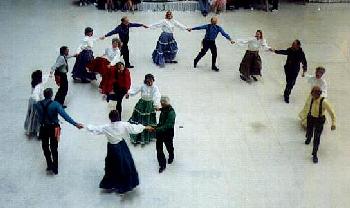
which is the spectacular figure used by many square dance teams for the conclusion of an exhibition. Lloyd Shaw, who possibly used it first for this purpose, took it straight out of Cecil Sharp's "Country Dance Book", and Sharp took it off the throbbing floor of the Pine Mountain Settlement School, and the ancestors of these dancers danced it with profound solemnity around a great tree, 1500 years ago, thus intending to communicate life and action to it. And Old Dan Tucker is one of those human sacrifice dances, like London Bridge, and, 1500 years ago, the one who was caught as "Old Dan" in the centre, as the dance ended, really had his head cut off! A Round SquareThe running set is more truly a round eight than a square eight. The action goes "around" the square rather than "across" it. You could almost separate round eight from square eight by whether or not you could do them in a "big set". The running set is done in a square; but the big set is like a "round for as many as will". Here - ten, sixteen, twenty couples join in a great ring and proceed exactly as described above. The effect, by the time the tenth couple start to follow up, is downright exciting. From a balcony above the floor, it looks like corn starting to pop, building up to a climax with a full popper, dying down after all the grains are popped. It is purely beautiful. Make a list of your favourite dances and see how many of them could be done with any even number of couples. Those that could not are hopelessly square dances - quadrilles. The people of the southern mountains did contras, in lines and circles. At just what point these joined the repertory we do not know, (Cecil Sharp taught them some English contras as late as 1917). But the French quadrille influence in this area did not come in until fairly recent times. Possibly the dances were never done to music, but certainly, before 1917, this dance must have weathered a period of fanatical Puritanism, during which the fiddle was the devil's instrument. We can scarcely estimate our debt to this great dance, for, besides having given us most of our western figures, and a joyous attitude toward dancing, the running set and its offspring probably kept dancing alive during this sterile period. Surely the play parties, which we shall discuss later, were fathered by the running set, whoever their maternal ancestor may have been, and we could not have survived without the play parties The running set had a caller, too - a real caller, America's only unique contribution to the square dance. If he were calling from the set, his call was a "prompt", but if he called from outside the set, he put in improvised "patter" of his own, the forerunner of the wonderful patter call of twenty years ago. Try something! Take a good old single visitor dance - say Lady Round The Lady. Dance it exactly as described above - "following up". Put on the best English square dance music in your file - it will probably be Glise a Sherbrook. (If you don't have an old tune, try Rubber Dolly) It is unlikely that you have the stamina to dance it at the 128 steps per minute at which it is recorded, but, if you think you are as tough as your Great-Grand-Dad, turn it up to 140. Don't walk - run. Just barely, lightly! After you have recovered from this, done in a square, put three or four sets in a big set and do Shoot the Owl or Birdie in a Cage. You may now go out and lie down flat on the lawn, and thank God for your ancestors!

|
||||||||||||
 |
 |
 |
 |
Created on June 25, 1999 - Last updated on January 14, 2025 |