|
Diese Seite in deutsch |
|
| |
 | |
|
Diese Seite in deutsch |
|
| |
| |
| American Folks Dancing has two great ancestors, one
English and one French. The subtle contribution of the French ancestors we
shall discuss a little later. The English ancestor was a strong,
mysterious stranger, but deeply our own, gathering into itself elements
from all the ritual lore of the ages, and giving out from itself a vast
treasure of figures, feelings, music and attitudes. This English ancestor
was the great Morris Dance. It must already have been very old in
1450 when we start our story. No one seems to be perfectly sure whether it
preceded the Country Dance that seems to have grown out of it, or
whether they grew up more or less side by side. For the purpose of
simplicity, let us assume that the Morris Dance was the immediate parent
of the Country Dance. It was a professional dance in a sense, as are our
"Exhibition dances" that are done by amateurs at festival and conventions.
It was not done by just anyone who felt like dancing, but by trained teams
who called themselves "Morris Men", and it was done with great gravity,
for it went back to a time when the coming of spring was a thing so
yearned for that it must be "danced" into being by the beating feet of the
children of men.
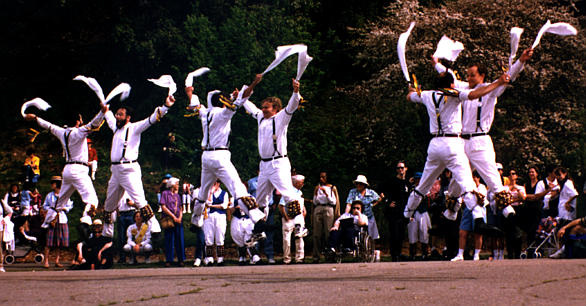
It went back to a time when winter was a spectre of dread after a lean harvest, and sacrifice (sometimes wheaten, sometimes animal, sometimes even human) was necessary in order to propitiate the gods of growing green. A century or two before, these Morris Men had been sword dancers, pantomiming a ritual that ended in human sacrifice. And, centuries before that, the sacrifice had actually taken place with the beheading of one of the dancers. London Bridge is a remnant of such a dance, so is We've Come to See Miss Jenny-a-Jones. Do not let this disturb you. Almost everything we do is a symbolic gesture for something out of our pagan and primitive past. It is good to know where the deep roots are. By 1450 the dance was just a vigorous and beautiful symbol, and the dancers used wooden slaves, or even clean handkerchiefs, instead of the awesome properties. A Man's DanceMorris Dances were danced by six men (remember, the women didn't count!) in two rows of three. Each wore a leather pad of bells fastened around each calf, and, because the purpose if the bells was to ring, the steps had to be vigorous enough to ring them. Try to imagine yourself dancing in a shortened set (lacking one couple) and visualize all the square dance figures that you could do. You could start with "forward six and fall back six". You could also do "forward and back vertically" (or "up and down"). You could do a "Dixie chain" and some of its variants. You could open out into a circle and "weave the ring" or "form a star". You could execute "pass through". All of these things they did. But all the time you would need to be ringing those bells, and you would do a sort of polka step in which instead of hopping on the last beat, you "kicked" that foot vigorously straight forward until the bells rang like mad. All the time the balls of your feet would be beating the turf.
When you did "weave the ring" with great bounding steps
(you would call it a "hey"), it would be so beautiful to behold, as your
lath "swords" or your white handkerchiefs worked themselves into the
pattern. There would be a jester in some outlandish costume at the head of
the set, but not to call. There was no caller, and whatever cues were
necessary were given by the leader of the six dancers. There would be an
improvised hobby horse, controlled by a man who stood in its middle. There
would be a man dressed like a woman, who represented MAID MARIAN, and
there might be FRIAR TUCK and other characters from ROBIN HOOD. There is a
500 year old stained glass window in a house in Staffordshire (England)
that shows exactly how everybody looked. A bag piper would be playing the
tunes: Glise a Sherbrook, Green Sleeves and Rakes of
Mallow. In spite of all this, if you were perceptive, you might say:
"It looks a lot like square dance!".
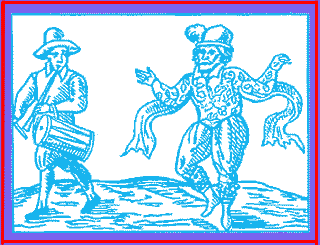
It took a strong man to be a Morris Man, a real athlete. There is a precious story of how a great Shakespearean jester, WILL KEMP, once danced all the way from London to Norwich (it is something like 80 miles (132 km) and it took him nine days) and of how, in one town, a lass came out and danced a mile with him to keep him company - bold wench. That was in 1580, as he made a bet, that he could do this in less than 10 days. As you know, he won the bet in what has since been known as "The Nine Daie's wonder" or, to Morris Dancers, "Kemp's Jig". (If you are curious, here is what Will Kemp said about his journey) Whence came the dancing, and from how far, onto the greens and courtyards of Henry's England? Is it Moorish (Morris) from North Africa? Could you have found it millenniums ago in ancient Crete? Who can say? How certainly it crossed the sea and found itself on the greens of Kentucky is somewhat easier to follow. Ask any good dance man (ballet, ballroom, folk or square) and he is very likely to say: "It all goes back to the Morris. Everything goes back to the Morris". We have done square for eight and rounds for eight, and our inexpert eyes may have difficulty in seeing any difference between them, but difference there is. Dull Sir John actually feels like an eastern quadrille, and Newcastle, which is a round for eight, feels like a western square dance, with its Texas star, and with everybody active at once. A Varied ProgramWe shall have done a number of "rounds for as many as will", marvellously varied, and some of them going back to the circular choral dances or the straight choral dances that were done in the naves of English churches, and are still danced an Corpus Christy Day in the Choir of the Cathedral in the city of Seville. (If you want to see what they are like, but on a record and dance Good Girl.) We may possibly have done a round with "two" couples facing "two" couples, weaving through each other in the beginnings of a "mescolanze", which was later to become "progressive square". And we shall have done several of those little "four" dances that were to be developed into more longways and squares. When we come back from our magical journey, we shall remember some of the beautiful tunes - Blew Cap, with its Scottish lilt - Faine I Would if I Could, Kemp's Jegge, Cathering Peascods, Spanish Jeepsies and that great Staines Morris. We shall remember how we sang some of the tunes and danced our own singing, while the bystanders joined in, just as we to today in Trail of the Lonesome Pine.If we were just ordinary tourists, we have been entertained on the village green, but if we were Very Important Persons - great merchants or ambassadors - we have been dancing at court. The English country dance went light-heartedly to court without a trance of an inferiority complex. Everybody danced it. It was so much more fun than the branles, gavottes and minuets that were being imported from the French court, that, during the reign of James I., the country dances were actually danced in the court by royal decree. A Lively DanceAs to the steps, they are free and expansive. The running steps are swift and light, the skips gay, and "slips" leap high, the walking steps are joyous. The little "pas-de-basque" of the "set" step is a joy to see. The knees are kept straight and the movement is in the ankle. The tempo of the music is quite fast. Later, when Scottish steps and figures began sifting in, the noble Scottish steps brightened the pattern like a red thread in a tartan. And, still later, Irish jig steps were included. But the English country dance never accepted the wonderful "seven and two threes" of the great Irish circle dances, nor has it to this day.As the years go by, thoughtful researchers begin more and more to feel that the country dance in English, "our" dance is English. Just because there are German square and French circles and Spanish lines we used to think that one must derive from another, but dance patterns are inevitable. Greek soldiers danced squares in the time of Xerxes, and Scottish soldiers dance them today. Of course, there must have been interchange from country to country. This is what makes the top of the tree so airy with twigs. But the English seem to have developed their own dance, and consequently ours, and the heart and soul of it is the great longways, containing as it does almost every conceivable square dance step and pattern. It was this "longways" dance that actually did make an
alliance in the French court, and forget the strong link between the
ballroom and village green, bringing forth the "contra" that in turn gave
us so much of what we have today. Do not forget that this longways dance
is older than the memory of man. |
 |
 |
 |
 |
Last updated on January 14, 2025 |