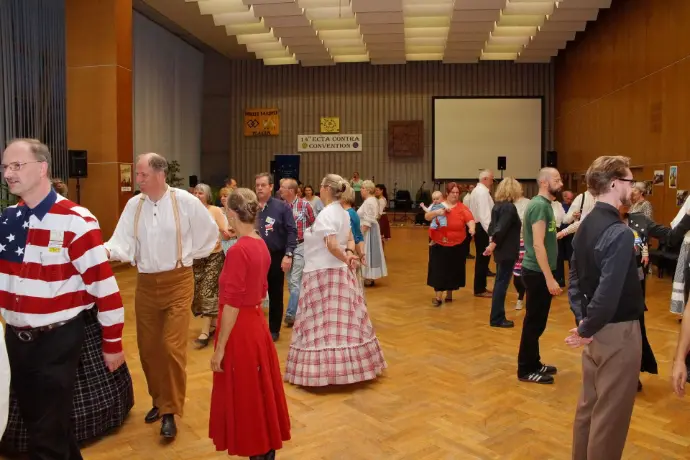
Contra Dance
Dancing takes place to a variety of music—ranging from Western tunes, Irish reels or jigs, and classical pieces to modern melodies—always in time with the music. Generally, no prior experience is required, though it helps to know a few basic square dance figures, such as "do-si-do" or "right and left thru." The sequence of figures for each dance is worked out and explained together. Most contra dances are built around a 64-beat sequence of figures called out by the prompter (similar to a square dance caller); this sequence is then repeated several times. Partners dance up the line (towards the prompter) or down the line (away from the prompter). As the dance progresses, the prompter reduces the number of calls, allowing dancers to enjoy moving solely to the music towards the end.
Traditionals are frequently danced in a square formation. Unlike Modern Western Square Dance, the sequence of figures is fixed. The dance is usually structured according to the "visiting couples principle": Couple No. 1 begins with a short sequence of figures with Couple No. 2, then moves to Couple No. 3 to dance the same sequence, and repeats it with Couple No. 4.
Quadrilles, too, consist of set sequences of figures performed in a square formation and modeled on court dances.
At larger events, dancing takes place to live music, which holds a special appeal. The prompter is not bound by the length of a recorded track, giving the dancers the opportunity to focus entirely on the music.
Has this sparked your interest? Why not give it a try yourself—we’ll see you in a "contra line."