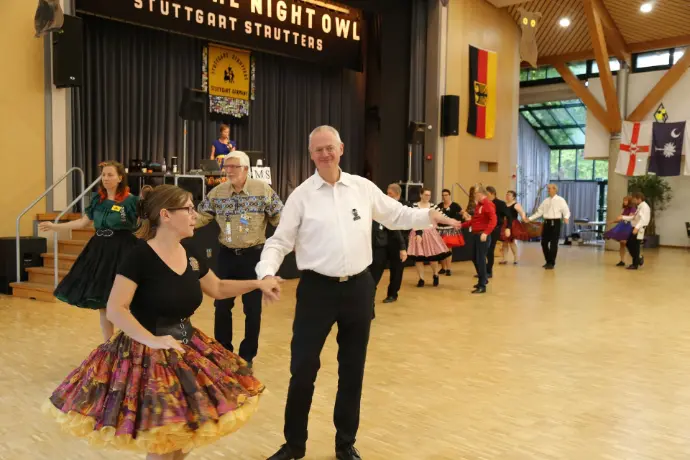
Round Dance
Unlike in ballroom dancing, routines aren’t memorized and led by the man; instead, individual steps are called out by a dance leader—the “cuer”—during the dance. On the one hand, this makes things easier, since there isn’t quite as much to memorize; on the other hand, it offers greater variety because the same routine isn’t danced over and over again. Of course, the man can and should still lead. This requires concentration and good listening skills.
Dancers perform to a variety of music styles (from country music to current hits). The Cuer's repertoire includes well-known artists and songs from nearly every musical genre.
Six phases (levels of difficulty) can be learned. Upon completion of the course, participants can put what they have learned into practice at many Round Dance associations, Square Dance clubs, and even at events.
As with square dancing, there are no competitions in round dancing.
We dance with each other, not against each other.
Round dance steps and figures are standardized, allowing dancers to dance at the corresponding events worldwide.