|
Diese Seite in deutsch |
|
|
|
 |
|
|
Diese Seite in deutsch |
|
|
|
|
|
|
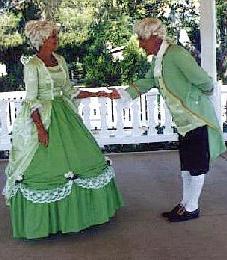
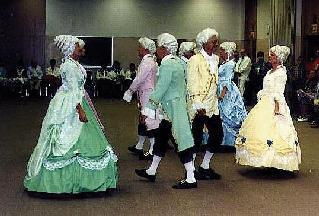
By the time of Louis XIII and Louis XIV, the "minuet" had been added to this repertory. The minuet had begun as a rather crude peasant dance, but as a court dance in became so important that we must include it in our chart; for all our sense of stepping beautifully goes back to this exquisite dance which reigned in a more or less modified form for several centuries. So short a time ago as the nineteen twenties, we had several very popular "square dancer's rounds" that were called minuets and were simplifications of the old steps (the Oxford Minuet is an example), and gavottes (the Glow Worm Gavotte). We would scarcely dare to say so, for fear no one would dance them, but some of the popular round dances of the current season are bound to be minuets or gavottes in this limited sense. Every round-dancing square dancer owes a very great debt to the minuet. We shall have to be very important people indeed to get ourselves invited to a court ball in the time of Louis XIII, but, when we do arrive, we are going to be very interested to see the king himself, with Anne of Austria on his arm, lead out the first branle and dance through one sequence before to sit on the throne and watch the others doing the long lines of stately and sometimes flirtatious figures all evening. It does not look in the least like anything we do today, but we are impressed to discover that the king is an excellent dancer. If we live long enough and are lucky enough to be invited back during the reign of the great Louis XIV, we shall find something astonishing going on, for here is the ballet beginning to flower, and the participants are amateurs! (This is almost the exact counterpart of a fine round dance exhibition team at a square dance convention.) Louis himself, resplendent as a god, is dancing the leading role, and aristocratic dilettantes fill in the cast. We are reduced to the role of spectators. We cannot join in that dance, and you must be beginning to wonder what it can possibly have to do with us. The answer lies in the fact that at about this time, the English Country Dance came leaping across the channel, with a basketful of its weaving patterns (patterns in which people like us could join) to be fitted to the careful stepping of these good dancers. It came chiefly in the form of the "longways for as many as will", and it tuck France by storm just as the 17th century turned to the 18th. There were country dances in Spain, in Germany, in France itself to which the French might have turned; they had dances of all shapes and sizes. But the English Longways had one feature that none of the others had: the gradual entrance of couple after couple, what Curt Sachs calls "the pleasing combination of the choral dance and the single couple dance".
Flexibility a factorYou did not have to have an exact number of couples, nor form an exact square or round. One after another the couples danced the same pattern to the same tune, working their way down from the head to the foot of the line, and, if a couple arrived late, they simply stepped in at the end of the set. By the time the action reached them, they knew what to do. Longways dances for as many as will used to work out like the boring modern version of the Virginia Reel, the first worked all the way down before the next took over. The Scots clung to this system (after all, what's your hurry?). The dance became enlivened by permitting every other couple to work through the figure with the alternate couple at the same time, so that no one was ever idle in the line. The dancers worked in little sets of two couples, doing the 'square for four', or sometimes every third couple was active in which case you had little sets of three couples (the Longways for six within the long longways!). The dance contained the seeds of all our quadrille figures: right-left-through, ladies chain and men's chain, Dixie chain and square-through, stars and bend-the-line, circles and balances, swings and allemand lefts. A Good Old Dance
There were also delightful odds and ends, like this introduction for
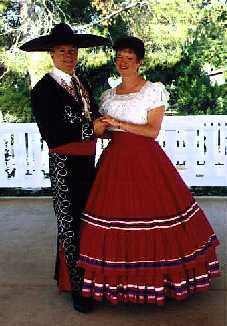
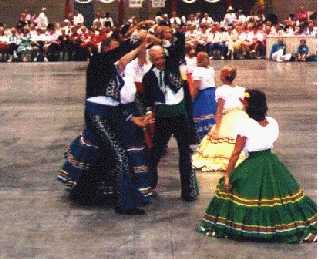
a part of a longways for six called All in Garden Green: then the 2nd; then the 3d by one hande, then the other, kisse her twice and turne her. Shake the 3d by the hande; then the 2nd; then your owne by one hande, then the other, kisse her twice and turne her" This is pure American square dance! And ... these English dances were magnificently available to French dancing masters. The London publisher Playford brought out in 1650 the first printed and purchasable book of instructions for these country dances, and followed it up with larger and larger editions, until the final edition of the "English Dancing Master" contained some 900 dances, most longways. What a treasure trove! These dances were fun! Indeed, at first, some French dancing masters considered them downright rowdy, and objected to the way the dancers leaped and turned and clogged and swung their bodies about. (A rowdy child of this rowdy dance exists to this day in the Can-Can.) But the patterns were marvellous, and soon the dancing masters got into the habit of travelling to England for new collections to take back to the Dauphin or the Duke. This sounds familiar! And so ... to the French we owe our gratitude for the "contredanse", for they took the longways, and gentled it down and polished it up and gave it a new name. Contre, in French, does not mean at all the same thing as country. It means counter ... the dance that is arranged with a line facing a line. (The Country dance includes ALL the English forms.) We accepted the name and called the dance a 'contra-dance'. Later, in New England, they shortened it to contry. The country longways and the courtly contra acknowledged each other across the set like good dancing partners, and then went reeling down their own lines, joining each other at the right-and-lefts, the stars and the chains. When they met and joined how they cluttered the twigs of that family tree! Some of our modern line dances are purely country and some are purely courtly. Dances with courtly titles, like Queen's Favourite and Queen Victoria indicate that they crossed the channel a second time, back to England with French manners. What about the Scots, whose relations with France were usually less strained than their relations with England? They contributed the "reel", most likely; via France? or via England? Their beautiful set step they hold in common with the English, but their fancy way of 'casting off' that they call a poussette ... well, it is a French word! If you would like to see the contre-danse today at its elegant best, you have to go no farther than California, where the glorious contradanzas of old Spanish California are being revived by loving round dance groups. Those Spanish colonists, like the rest of us, must have had to make a courteous little bow to France, as they devised these lovely squares and lines and circles in waltz time.

|
||||||||||||
 |
 |
 |
 |
Created on June 25, 1999 - Last updated on January 14, 2025 |