|
Diese Seite in deutsch |
|
|
|
 |
|
|
Diese Seite in deutsch |
|
|
|
|
|
|
By the beginning of the 18th century, the English gentry were beginning to forget their country dance, and were doing little jigs and round-abouts, and, later, polkas. They were forgetting the longways, the round for as many as will, the round eight, and the square eight. If you will study the chart for a minute, you will see that this square for eight - the TRUE square dance - came very near to being left, ungathered, far out on the end of a limb, like a nice, ripe peach out of reach of the ladder. Its survival seems to have depended on the round for eight, which the French discovered next. They whisked it across the channel and transformed it into a thing they called the "contredanse francaise", and they must have included the square for eight along with it because they, like the rest of us, had a hard time telling the difference. What did it matter? Petticoat DanceWhat they built out of this material was not a contra dance: it WAS a square dance. They soon evolved a name for it of its own - Cotillon. Cotillon means petticoat, and the name may have come from a popular song of the time that says My dear, when I dance, does my petticoat show? We suppose that she hoped that it did, for it was a very pretty one. It was as if they had taken a little thatched and steep roofed English cottage with a garden and a brook, and transformed it into French chateau with lawns and clipped hedges and a fountain with a pool. The cotillon was strictly square in formation and strictly country as to figure. Its great fault was monotony. Endless repetitions of the same few figure in endless dances killed the cotillon. An attempt was made to revive it during the 19th century by introducing so much variety that the dance degenerated. In America, a cotillion (spelled with an "i") developed as a certain kind of wonderful party at which no two dances were alike and the whole arrangement was most elaborate, with little favours for the ladies at the end of each dance. The true cotillion, which deserves to be revived, has been lost for half a century, and, while the word is still used, it is meaningless. The only reason that we include the cotillon in our story is the fact that it seems to have led up to the great quadrille, and this is a name that must be written in capitals. THE GREAT QUADRILLE!The word, of course, means "foursome" - a dance done by four couples in a four-sided figure. The light-hearted square eight found itself all dressed up in a setting of five figures, the first of which was usually some kind of cross-over, such as "head couples right and left through and the side the same". Then there might be a forward and back figure; and than an Alamo style balance four in line, with frills; then perhaps a circle eight with a four ladies' grand chain; and then a basked figure. You modern square dancers could do any of them at the drop of a hat.
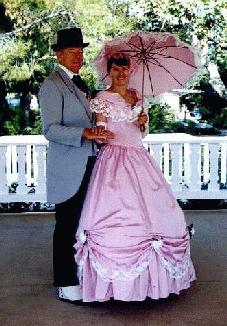
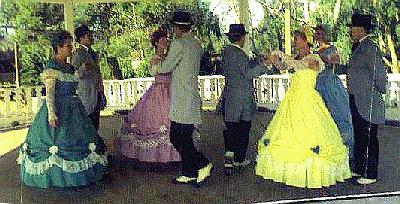
The dance must have missed its gay music, the wonderfully-wrought English and Scottish tunes, but the new music was beautiful too, played by strings and woodwinds instead of pipes and oboes and bombardons. They used semi-classical dance music, opera tunes, and a great deal of music composed especially for these quadrilles by well known composers. We are in the middle of the 19th century by now, and you cannot possibly do this dance on the village green. The ladies' skirts are yards and yards around, ruffled and puffed over hoops until they look like huge walking lampshades. The gentlemen are wearing long trousers at last tight trousers and shirts with linen ruffles, and elaborate waistcoats. You need a glistening dance floor, a big one. You need light from hundreds of candles in crystal chandeliers. You need a platform for the musicians. And you really need, for the first time, a Prompter. Not a caller, yet, but someone to indicate briefly what is coming next. It would be unthinkable for one of the dancers to shout - "ladies'chain!". The square dance, strong grand-child of the longways and the court ballet, sweet child of the square eight and the round eight, had come into the ballroom. And there it stayed, for a century and a half, with a glorious heyday in American ballrooms at the end. At the same time that this was happening, occurred one of the great breakthroughs in the history of the dance; the Polka came bouncing in on thistle-down toes, hand in hand with the Waltz, and the "couple dance" was born. Not that the couple dance had not always been done, for it is an ancient dance form, deeply ritualistic in its representation of the relationship of a man to a woman, and often truly virginal in its manner of performance. There was nothing ritualistic about it in the late 18th century, when a tall man took a lovely woman close in his arms, and whirled endlessly around a gleaming dance floor to the most beautiful dance music the world has ever known, the waltz. Or when he doubled his erstwhile dignified knees into the most delicate of hops, and the little peasant polka became the darling of the teakwood floor. We should speak of the difference between a "couple dance" and a "round dance", and ask why we call a round something quite different from that "round for as many as will" of the English country dance. Actually, it is not so very different. Our round dance is a dance with a definite pattern, done not by a couple but by a group of couples, moving in unison in the same direction, doing the same step on the same beat of the music. The individual couple has no freedom of movement whatsoever - only of styling. A couple dance, on the other hand, belong to the individual couple. If there is room, it can sweep all over the floor, improvising its own pattern. The gentleman may whisper into his lady's ear, (or he may be skilful enough to whisper with his hands alone), when the cadence of the music demands: "twinkle", or "lift", or "cross over". It is the only truly creative dance we have left (unless you are interested in Jitterbug). It was shocking when it first invaded the ballroom, and, like many things initially shocking, it turned out to be one of man's better inventions. What has this to do with the history of square dancing? Much! For here were two things born to be wed!. You could do the patterns of a quadrille to the steps of a waltz, and what resulted was the queen of all square dances. You could do it to a polka too, or a mazurka, or a redowa. On the branch of the plain quadrille a whole bouquet of the loveliest flowers burst into bloom: the polka quadrille, the mazurka quadrille, the waltz quadrille. We should have clung to this waltz quadrille like grim death. It was our dearest treasure, our dance of dances. 
|
||||||
 |
 |
 |
 |
Created on June 25, 1999 - Last updated on January 14, 2025 |